
MoEngage's first acquisition is a useful signal for anyone building apps, ecommerce products, SaaS tools, or consumer brands.
On June 24, 2026, reports said MoEngage acquired San Francisco-based Aampe, an AI startup focused on autonomous personalization for individual users. The Economic Times described it as MoEngage's first acquisition and said the company is looking to deepen its AI capabilities. Other current coverage, citing TechCrunch, described the deal as a move toward AI agents that can make customer engagement decisions at an individual-user level.
The story matters because it shows where marketing technology is heading. For years, customer engagement has been built around segments, rules, journeys, triggers, and dashboards. Those tools are still useful. But the center of gravity is moving toward AI systems that learn, test, and adapt continuously.
For Diveno Labs readers, the question is not whether every business should buy the latest customer engagement platform. The better question is what this shift means for product teams trying to keep users engaged without spamming them, annoying them, or losing trust.

The short version
MoEngage is already positioning itself as an agentic customer engagement platform. Earlier in June, the company announced Merlin AI Custom Agents, saying marketers can create workflow agents that run on MoEngage data, operate inside marketer-defined guardrails, and expose activity logs showing what the agent did.
Aampe adds a different but related piece: personalization infrastructure built around agents that learn from customer behavior and adapt experiences over time. Aampe's own site describes its agentic AI as learning and adapting to customer behavior automatically, while its MoEngage marketplace page describes personalized mobile messaging that uses MoEngage Push APIs.
Put together, the direction is clear:
- marketers want less manual campaign assembly
- product teams want more relevant customer experiences
- AI agents are being pushed into retention, messaging, journey design, analytics, and experimentation
- guardrails and visibility are becoming central because autonomous marketing without control is risky
This acquisition is not just a startup M&A note. It is a snapshot of the next phase of customer engagement software.
What Aampe brings to the story
Aampe has been focused on adaptive personalization for mobile apps and customer engagement. Older TechCrunch coverage described Aampe as a marketing automation platform for mobile apps that relies on AI algorithms, app event streams, and experimentation rather than only human-defined rules.
That framing still matters. The traditional way to run lifecycle marketing is to define segments and triggers:
- users who abandoned cart
- users inactive for seven days
- users who viewed a product twice
- users who completed onboarding
- users who used a feature once but did not return
Then a marketer writes campaigns for those segments and schedules messages across push, email, SMS, in-app messages, or other channels.
The agentic version tries to move closer to the individual. Instead of asking only "which segment is this user in?", the system asks "what should this specific user receive, when, through which channel, and how should we adapt based on the result?"

That is powerful, but it also raises the bar. If a product sends more personalized messages, those messages must be useful. Bad personalization feels worse than generic communication because users can tell the system is trying to be clever without being helpful.
Why this matters for apps
Most mobile apps have a retention problem. People install, try the app once or twice, and disappear. Product teams respond with notifications, emails, discounts, streaks, reminders, and onboarding flows.
Some of that helps. Much of it becomes noise.
Agentic customer engagement is attractive because it promises to reduce the manual guesswork. Instead of one team trying to decide the perfect message sequence for every user group, agents can test, learn, and adapt. They can notice that one user responds to practical reminders, another responds to educational content, and another should not be messaged for a while.
For useful apps, this can be good. A finance app can remind someone at the right moment. A learning app can nudge a user before they lose momentum. A productivity app can surface the next action without turning into notification spam. A retail app can recommend a relevant offer without shouting at everyone.
But the product principle remains the same: engagement should serve the user, not only the metric.
If AI agents optimize only for clicks, they can become aggressive. If they optimize for long-term retention, trust, and user value, they can improve the product experience.
The guardrail problem
MoEngage's June 3 Merlin AI Custom Agents announcement is useful context because it leans heavily on visibility and marketer-defined guardrails. The company said teams can define rules, see what data an agent pulled, understand what decisions it made, and choose whether actions require review.
That language is important. Marketing AI that acts autonomously can create real risk:
- sending too many messages
- making inappropriate offers
- contacting users through the wrong channel
- using sensitive attributes badly
- creating inconsistent brand voice
- harming trust with over-personalization
- optimizing short-term conversion at the expense of long-term loyalty

This is why the agentic customer engagement market cannot only be about automation. It has to be about controlled automation. Teams need to know what an agent is allowed to do, what it is not allowed to do, who reviews sensitive changes, and how results are measured.
For startups, this is a major product lesson. Do not give an AI system broad customer-facing power without product rules, consent boundaries, and rollback paths.
Why marketers are moving beyond segments
Segments are useful because they simplify complexity. But they also flatten people.
Two users may both be "inactive for seven days" while having completely different reasons. One may be busy. One may be confused. One may have found a competitor. One may have completed the job they came for. One may still like the product but hate push notifications.
Rule-based campaigns can only handle so many variations before the journey map becomes impossible to maintain.
AI agents promise a more adaptive layer. They can test more combinations, respond to behavior, and learn from outcomes. That does not make marketers irrelevant. It changes the marketer's role from manually defining every branch to setting strategy, constraints, content quality, brand rules, and success metrics.
In a healthy setup, humans still decide:
- what the brand should sound like
- which channels are acceptable
- what consent is required
- what offers are allowed
- what user outcomes matter
- when the agent must ask for approval
The agent handles more of the repetitive experimentation and execution.
What this means for ecommerce and consumer brands
Ecommerce brands are likely to be among the earliest adopters of this kind of agentic engagement. The use cases are obvious:
- cart recovery
- product recommendations
- repeat purchase reminders
- loyalty nudges
- back-in-stock alerts
- price-drop communication
- personalized onboarding
- churn prevention
But ecommerce also shows the danger. A brand that pushes too hard can train customers to ignore it. A brand that personalizes poorly can feel invasive. A brand that discounts automatically can destroy margin.
Agentic systems should not be judged only by message volume or campaign speed. They should be judged by healthier customer behavior: fewer irrelevant messages, better retention, higher trust, lower unsubscribe rates, and better lifetime value.
That is why data discipline matters. If events are messy, consent is unclear, product catalog data is poor, or customer states are inaccurate, an AI agent will optimize on weak foundations.
What this means for startups evaluating tools
The acquisition will make many founders and growth teams ask whether they need agentic customer engagement now.
The answer depends on stage.
If you are still trying to understand who your users are and why they stay, do not rush into complex automation. Talk to users. Fix onboarding. Improve the product. Track the core events that show real value. Build a clean lifecycle map.
If you already have meaningful usage, multiple journeys, and a real retention challenge, agentic tools may be worth testing. But the evaluation should be practical.

Ask vendors:
- Can we see why an agent made a decision?
- Can we approve actions before they go live?
- Can we limit channels, budgets, audiences, and frequency?
- Can we exclude sensitive user groups?
- Can we measure long-term retention, not just clicks?
- Can we export logs for audit?
- Can we stop or roll back an agent quickly?
- Can the system respect consent and regional privacy rules?
Those questions matter more than whether the demo looks futuristic.
Why mobile engagement is the center of this
Aampe's background in mobile app marketing is significant because mobile engagement is difficult. Phones are intimate devices. Notifications interrupt real life. A bad message is not just ignored; it can make a user uninstall.
The best mobile engagement feels timely and respectful. It helps the user do something they already care about. The worst mobile engagement feels like a desperate growth hack.
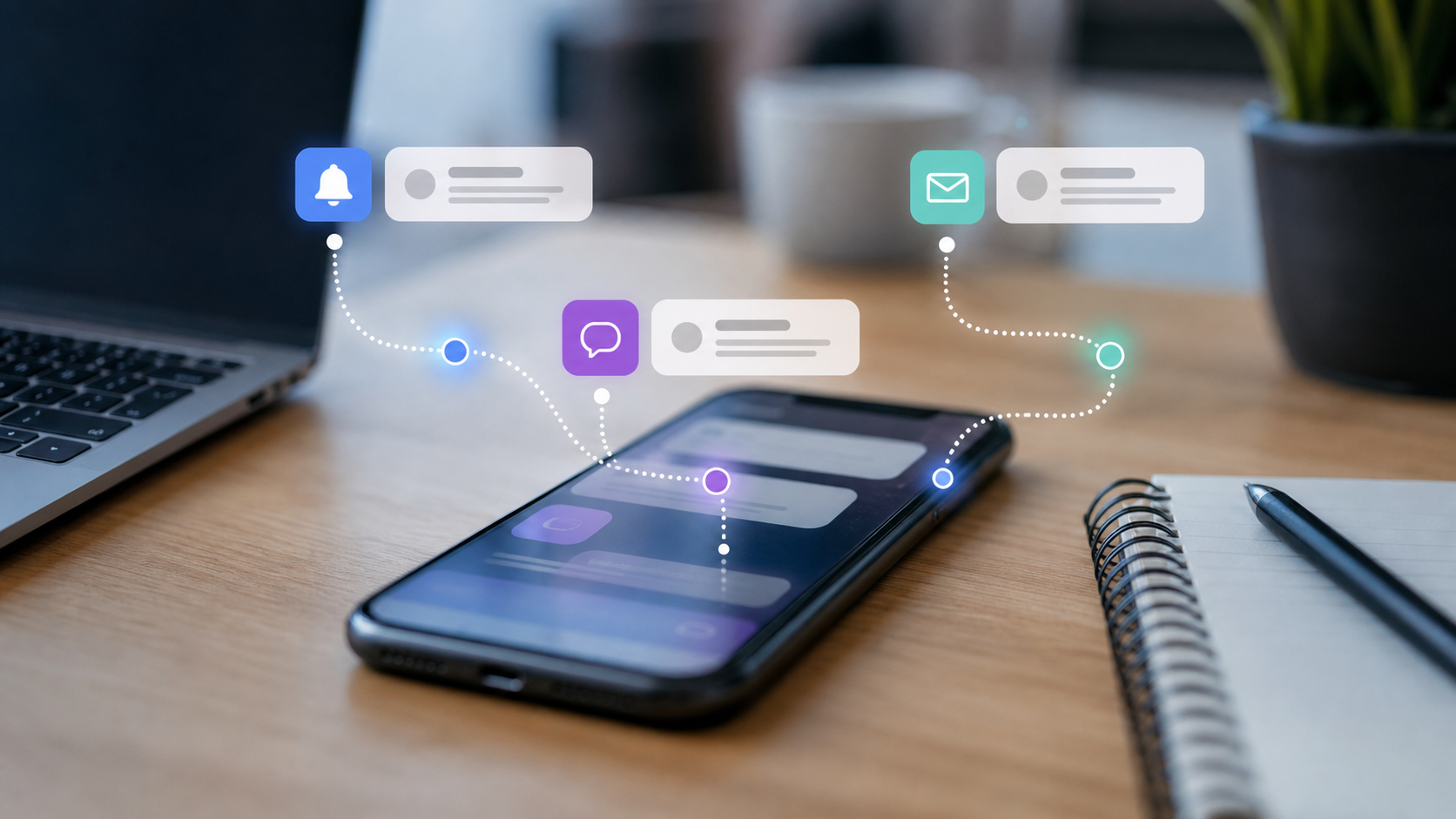
AI agents can make both outcomes more extreme. A well-designed agent can reduce irrelevant messages by learning user preferences. A poorly designed one can increase annoyance by testing too aggressively.
That is why frequency caps, quiet hours, channel preferences, opt-outs, and user-level consent should not be afterthoughts. They are product features.
The architecture behind the product shift
The acquisition also points to a broader architecture shift in customer engagement platforms.
Traditional systems are organized around campaigns. A marketer defines an audience, writes content, chooses a channel, schedules delivery, and checks performance. That workflow is still useful for announcements, launches, promotions, and one-time communications.
Agentic systems are organized more around continuous decisions. The platform needs to know the customer state, the available channels, the content options, the business goal, the constraints, and the history of what already happened. Then it has to choose the next best action repeatedly.
That means customer engagement platforms increasingly need:
- event streams from apps and websites
- identity resolution across devices and channels
- consent and preference records
- content libraries
- experimentation systems
- decision logs
- approval workflows
- performance feedback loops
This is why MoEngage's Merlin announcement matters alongside Aampe. An agent without visibility is difficult to trust. A marketer needs to know why a system chose a message, what data it used, and whether the action stayed inside approved rules.
For builders, this is a reminder that AI features often require non-AI infrastructure. The model is only one part of the system. Data quality, permissions, logs, UI controls, and measurement decide whether the feature works in production.
What good agentic engagement should feel like
The best version of agentic engagement should feel quieter, not louder.
A user should receive fewer irrelevant messages. A customer should see offers that fit their context. A learner should get nudges that help them continue. A shopper should not receive the same abandoned-cart prompt five times after they already decided not to buy. A SaaS user should get onboarding help at the moment of confusion, not a generic email sequence three days later.
This is where AI can be useful. It can notice patterns that a manually managed campaign calendar misses. It can adapt timing, channel, and content. It can stop sending messages when the data suggests a user needs space.
But that outcome depends on the goal the team sets. If the goal is only "more sends" or "more opens," the system may become noisy. If the goal includes long-term retention, unsubscribe rate, complaint rate, customer value, and brand trust, the system has a better chance of serving users.
Good customer engagement is a product experience. It should be judged with the same care as onboarding, checkout, search, support, and pricing.
The privacy and consent layer
Customer engagement AI depends on data. The more personal the experience, the more important privacy becomes.
Teams need to be careful about what signals they use, how long they keep them, who can access them, and whether customers have given proper consent. Personalization should not become surveillance dressed up as convenience.

The practical rule is simple: collect only what you need, explain how it is used, respect opt-outs, protect customer data, and avoid sensitive inference unless there is a clear and compliant reason.
For Indian startups and global SaaS teams, this is especially important because customer engagement often crosses channels and markets. A product may send email, WhatsApp, push notifications, in-app prompts, SMS, and web personalization across regions with different rules. AI agents need to operate inside those constraints.
Why India-facing companies should watch this
MoEngage has deep relevance for India-facing startups and brands because mobile-first engagement is central to the Indian internet market. Many businesses depend on app installs, repeat purchases, WhatsApp-like communication habits, push notifications, and multilingual customer journeys.
The acquisition does not mean every Indian app will suddenly use autonomous agents. It does suggest that large engagement platforms are preparing for a market where brands expect more personalization without hiring large lifecycle teams.
That could matter for:
- fintech apps trying to educate users without overwhelming them
- ecommerce brands managing repeat purchase cycles
- education apps supporting learning streaks
- health and wellness apps sending reminders carefully
- productivity apps helping users build habits
- local services trying to re-engage customers at the right moment
The challenge in India is not only personalization. It is language, trust, frequency, consent, and channel preference. A message that works in English email may fail in Hindi push notifications. A discount-heavy ecommerce nudge may not fit a premium brand. A reminder that feels helpful in one category may feel intrusive in another.
AI agents can test and adapt, but product teams still need cultural and customer understanding. Automation cannot replace taste.
What product teams should do before adopting agentic engagement
Before adding an agentic engagement platform, product teams should clean up the basics.
First, define the value moment. What action proves the user is getting value? In a task app, it may be completing tasks consistently. In an education app, it may be finishing lessons. In ecommerce, it may be finding and buying relevant products without regret.
Second, instrument events clearly. AI agents need reliable signals. If important events are missing or duplicated, personalization becomes guesswork.
Third, map consent. Know which users can receive which types of messages through which channels.
Fourth, create messaging principles. Decide what the brand will never do, even if it increases short-term clicks.
Fifth, choose metrics carefully. Do not optimize only for open rates. Measure retention, repeat use, revenue quality, complaints, unsubscribes, and user trust.
Agentic tools work best when they amplify a thoughtful product strategy. They cannot rescue a confusing product or careless communication model.
Metrics that matter more than open rate
Marketing tools often make it easy to celebrate open rates, click rates, and message volume. Those numbers are visible and fast. They are also incomplete.
An AI agent can improve open rates while harming the customer relationship. It can learn which subject line gets attention, but not whether the product is becoming more valuable. It can trigger more clicks, but not necessarily better retention.
Product and growth teams should measure a broader set of outcomes:
- activation rate
- repeat usage
- purchase quality
- subscription retention
- churn reduction
- unsubscribe rate
- notification opt-out rate
- complaint rate
- support tickets caused by campaigns
- long-term customer value
The best customer engagement systems connect marketing outcomes to product outcomes. A learning app should care whether learners complete lessons. A task app should care whether users finish meaningful tasks. An ecommerce brand should care whether customers buy products they keep, not only whether they click a discount.
Agentic engagement should be accountable to those deeper outcomes.
Mistakes to avoid
The move toward AI agents will create predictable mistakes.
The first mistake is automating too early. If your onboarding is confusing, your product value is unclear, or your event tracking is broken, AI messaging will not fix the root problem.
The second mistake is giving the agent too much freedom. Autonomous does not mean unconstrained. Teams need channel limits, frequency caps, approval rules, exclusion lists, and rollback controls.
The third mistake is treating every user as a conversion target. Some users need education. Some need support. Some need time. Some should not be contacted. A respectful engagement system knows when to stay quiet.
The fourth mistake is ignoring creative quality. Personalization does not make weak messaging good. The words, tone, offer, timing, and visual context still matter.
The fifth mistake is forgetting privacy. If users feel watched instead of helped, the personalization strategy has failed.
These mistakes are avoidable if teams treat AI engagement as a product capability, not just a marketing shortcut.
What to watch next
After this acquisition, the interesting questions are practical.
How quickly will Aampe's technology appear inside MoEngage workflows? How much control will marketers have over autonomous decisions? How transparent will the decision logs be? Will the system support human review for sensitive campaigns? Will brands be able to optimize for long-term retention rather than only campaign metrics?
The answers will determine whether agentic customer engagement becomes a useful operating layer or just a new label for old automation.
The broader market will move in the same direction. Customer engagement vendors, CRM platforms, analytics tools, and ecommerce systems will all add more AI decisioning. The difference will come down to trust: which tools give teams enough visibility, control, and measurement to let agents touch real customers?
The Diveno Labs take
MoEngage acquiring Aampe is a timely sign of where customer engagement is moving. The next generation of marketing tools will not only schedule campaigns. They will learn, decide, test, and adapt.
That shift can help brands communicate more usefully. It can also create new risks if teams hand customer touchpoints to AI systems without guardrails.
For app builders and startups, the takeaway is practical. Start by building a product worth returning to. Track meaningful behavior. Respect consent. Write messages that help users. Then consider AI agents where the complexity of journeys has outgrown manual rules.
The winners in agentic customer engagement will not be the teams that automate the most messages. They will be the teams that use AI to make fewer, better, more respectful interactions.
Source notes
Sources checked on June 24, 2026:
- The Economic Times: MoEngage acquires AI startup Aampe in first acquisition
- MoEngage / CNW: MoEngage launches Merlin AI Custom Agents with visibility, guardrails, and MCP architecture
- Aampe: Agentic infrastructure for personalized experiences
- MoEngage App Marketplace: Aampe integration
- TechCrunch: Aampe aims to personalize app marketing with algorithms
- Mezha summary citing TechCrunch current coverage of the MoEngage-Aampe acquisition
Image notes:
- All images in this post were generated with the GPT image generation model for Diveno Labs and saved under
/public/blog-images.
Frequently asked questions
What happened between MoEngage and Aampe?
MoEngage acquired Aampe, a San Francisco-based AI startup focused on autonomous personalization and customer engagement, in its first acquisition.
Why does this acquisition matter?
It signals a shift in marketing technology from manually defined segments and campaigns toward AI agents that learn from individual customer behavior and adapt messaging over time.
Should small apps use agentic customer engagement immediately?
Small apps should first clean up event tracking, consent, messaging quality, and retention goals. Agentic tools are useful only when the underlying product and data foundations are solid.
Build with Diveno Labs
Turn this idea into a working system.
Share the workflow, product, or content bottleneck you want to improve. We will help shape it into a practical build.
Build smarter product workflows with Diveno Labs