
Security news often gets summarized as a count. Thirty-three browser fixes. Forty browser fixes. Two hundred and forty-five enterprise patches. One hundred remotely exploitable issues. About one hundred and twenty critical bugs. Those numbers matter, but they are not the real story.
The real story is operational pressure.
On June 17, 2026, Oracle released its second monthly Critical Security Patch Update. The same patch window also brought fresh Chrome and Firefox updates addressing critical and high-severity flaws. Read separately, each release looks familiar. Read together, they form a useful picture of how modern security work actually feels for software teams: the attack surface is broad, the patch rhythm is faster, and there is less room for slow, calendar-based response habits.
For Diveno Labs readers, the interesting part is not “vendors shipped fixes again.” The interesting part is what this says about the systems we build and depend on:
- browser surfaces remain a live memory-safety and sandbox-risk zone
- enterprise software estates still carry large patch backlogs every month
- teams that treat patching as a side chore are falling behind the shape of real risk
This post breaks down the June 17 patch wave in practical terms and explains what engineering, IT, product, and operations teams should do with information like this.

The short version
Here is what shipped across the sources checked for this post.
SecurityWeek reported on June 17 that Oracle’s latest monthly Critical Security Patch Update delivered 245 new patches across products including Communications, E-Business Suite, Enterprise Manager, Fusion Middleware, JD Edwards, MySQL, PeopleSoft, Siebel CRM, Supply Chain, Systems, and Virtualization. The same report says roughly 120 vulnerabilities were rated critical and 100 could be exploited remotely without authentication.
Oracle’s own June 2026 advisory shows how broad the product spread is. It lists, for example:
- 3 new patches for Oracle Communications, all remotely exploitable without authentication
- 55 new patches for Oracle E-Business Suite, 6 remotely exploitable without authentication
- 10 new patches for Oracle Virtualization
On the browser side, Google’s June 16 Chrome stable release for desktop updated Chrome to 149.0.7827.155/.156 for Windows and Mac and 149.0.7827.155 for Linux. Google says that update includes 33 security fixes, including seven critical issues such as use-after-free flaws in WebShare, Digital Credentials, Passwords, and Web Authentication.
Mozilla’s Firefox 152 advisory, announced June 16, rates the release impact as high and lists high-severity issues including privilege escalation in WebRender, a use-after-free bug in the HTTP stack, a use-after-free bug in WebGPU, and several sandbox-escape issues in workers, navigation, process sandboxing, and networking.
SecurityWeek summarizes the browser window this way: over 70 vulnerabilities addressed across Chrome and Firefox, with multiple memory-safety bugs that could potentially lead to remote code execution.
That is the event summary.
The more important part is what these releases mean when you run real products, real employee fleets, and real internal systems.
Why this patch window is more important than it looks
It is tempting to separate browser security from enterprise application patching. Many organizations do that in practice:
- browsers are “endpoint” work
- Oracle is “enterprise app” work
- cloud systems are “infra” work
- code vulnerabilities are “AppSec” work
Attackers do not care about those org-chart boundaries.
From a risk standpoint, these systems overlap constantly:
- employees access internal apps through browsers
- admins manage enterprise tools through browsers
- support staff live inside browser-based consoles
- privileged workflows often depend on browser sessions, cookies, SSO, and extensions
- enterprise platforms like Oracle sit behind identity, network, and browser layers that all need to hold
That means a browser exploit chain and an unpatched enterprise system are not separate realities. They can be consecutive steps in the same compromise path.
The June 17 patch wave is a reminder that security is not a collection of isolated vendor bulletins. It is a stack of time-sensitive maintenance obligations across user surfaces, middleware, admin workflows, and core business systems.
Oracle's monthly cadence is the real operational change
The single most important Oracle detail is not just the 245-patch count. It is that this is the second monthly Critical Security Patch Update since Oracle began releasing monthly patches in addition to its quarterly Critical Patch Updates.
That changes the rhythm.
A quarterly mindset is fundamentally different from a monthly one. When patches come quarterly, many organizations build a predictable administrative cycle around them. When severe fixes begin arriving monthly, teams need a more routine, lower-friction patch process.
SecurityWeek notes that Oracle made the shift to supplement quarterly updates with monthly patches to address more severe vulnerabilities faster. That is the right vendor move, but it creates a harder customer reality:
- patch evaluation has to happen more often
- prioritization has to be quicker
- change windows need to be more flexible
- “we will handle it in the next big cycle” becomes less defensible
This is especially relevant for organizations that use Oracle across multiple business-critical areas. SecurityWeek’s June 17 report says the latest update spans Communications, E-Business Suite, Enterprise Manager, Fusion Middleware, JD Edwards, MySQL, PeopleSoft, Siebel CRM, Supply Chain, Systems, and Virtualization. That is not one team’s backlog. That is often several teams, several vendors, several change boards, and several outage sensitivities.
The Oracle numbers are operationally uncomfortable on purpose
Oracle’s own advisory is careful and structured. SecurityWeek’s June 17 reporting makes the scale easier to digest at a glance:
- 245 new patches total
- roughly 120 critical-severity issues
- 100 vulnerabilities remotely exploitable without authentication
- more than 100 patched issues in Oracle Fusion Middleware alone
Those numbers matter because they show how quickly enterprise risk accumulates when organizations defer patch hygiene.
Not every vulnerability will be relevant to every deployment. Not every critical score translates into the same real-world urgency. But the volume alone means teams cannot wait for perfect certainty before acting. A mature process has to be able to classify systems fast:
- externally exposed or internal only
- internet reachable or segmented
- identity-adjacent or not
- privileged administration path or not
- production critical or lower tier
- compensating controls present or absent
Oracle’s advisory itself reinforces that customers must conduct their own risk analysis based on how products are used. That is exactly right. The risk score is not the whole answer. But if a team still needs days just to figure out where a product is deployed, the organization has a patch-visibility problem before it even has a patching problem.
Browsers are still one of the most underestimated enterprise risks
Browser updates have a strange cultural problem. Because they are frequent and familiar, they can feel routine. Yet browser vulnerabilities often touch the most exposed software surface in the organization.
Google’s June 16 stable update says Chrome 149.0.7827.155/.156 for Windows and Mac and 149.0.7827.155 for Linux includes 33 security fixes. The advisory lists seven critical issues, including:
- use-after-free in WebShare
- inappropriate implementation in WebView
- use-after-free in Digital Credentials
- use-after-free in File Input
- use-after-free in Passwords
- use-after-free in Web Authentication
Mozilla’s Firefox 152 advisory is similarly serious. It marks the release impact as high and lists high-severity issues including:
- privilege escalation in WebRender
- memory-safety bugs
- use-after-free in HTTP
- incorrect boundary conditions in Web Audio
- use-after-free in WebGPU
- multiple sandbox escapes in workers, navigation, process sandboxing, and networking
SecurityWeek’s summary is blunt and useful: the updates address multiple memory-safety bugs that could potentially lead to remote code execution.
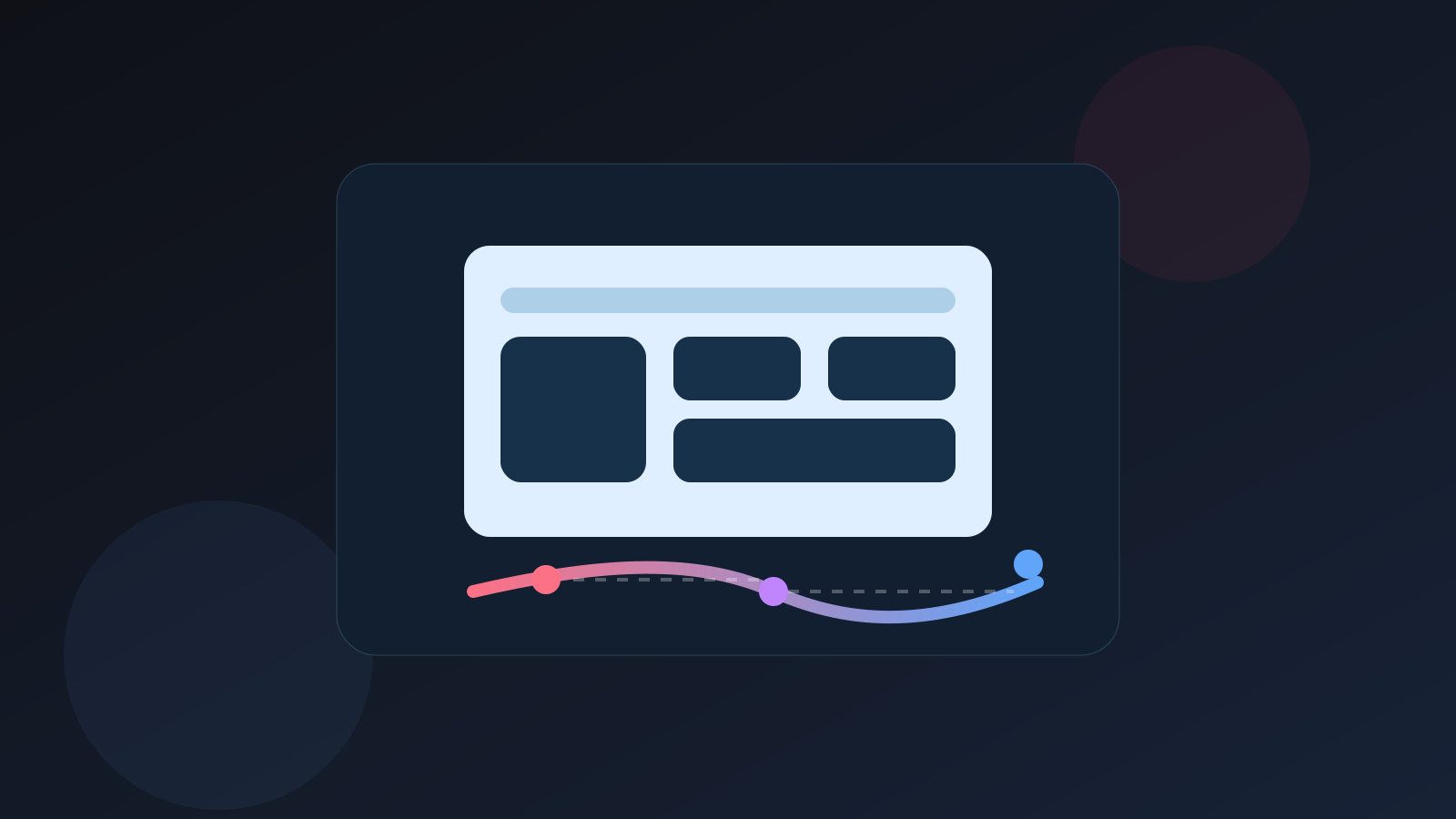
That should matter to any company whose operations rely on the web, which now means nearly every company.
Why memory-safety bugs keep showing up in patch notes
One of the most noticeable patterns in both browser advisories is how often use-after-free and related memory-safety issues appear.
This is not a surprise. Browsers are massive, complex software systems with:
- rendering engines
- networking stacks
- media processing
- graphics paths
- JITs
- sandbox boundaries
- plugin and extension surfaces
- credential flows
The browser is effectively an operating environment, not a simple application window.
For product teams, this matters in two ways.
First, your users experience your software through that environment. Even if your application code is secure, the execution surface still depends on browser integrity.
Second, a lot of business tooling now lives in privileged browser sessions:
- cloud consoles
- internal admin tools
- customer support dashboards
- finance and HR systems
- devtools
- identity providers
That means browser patch lag is not just a “desktop IT” concern. It is part of application risk management.
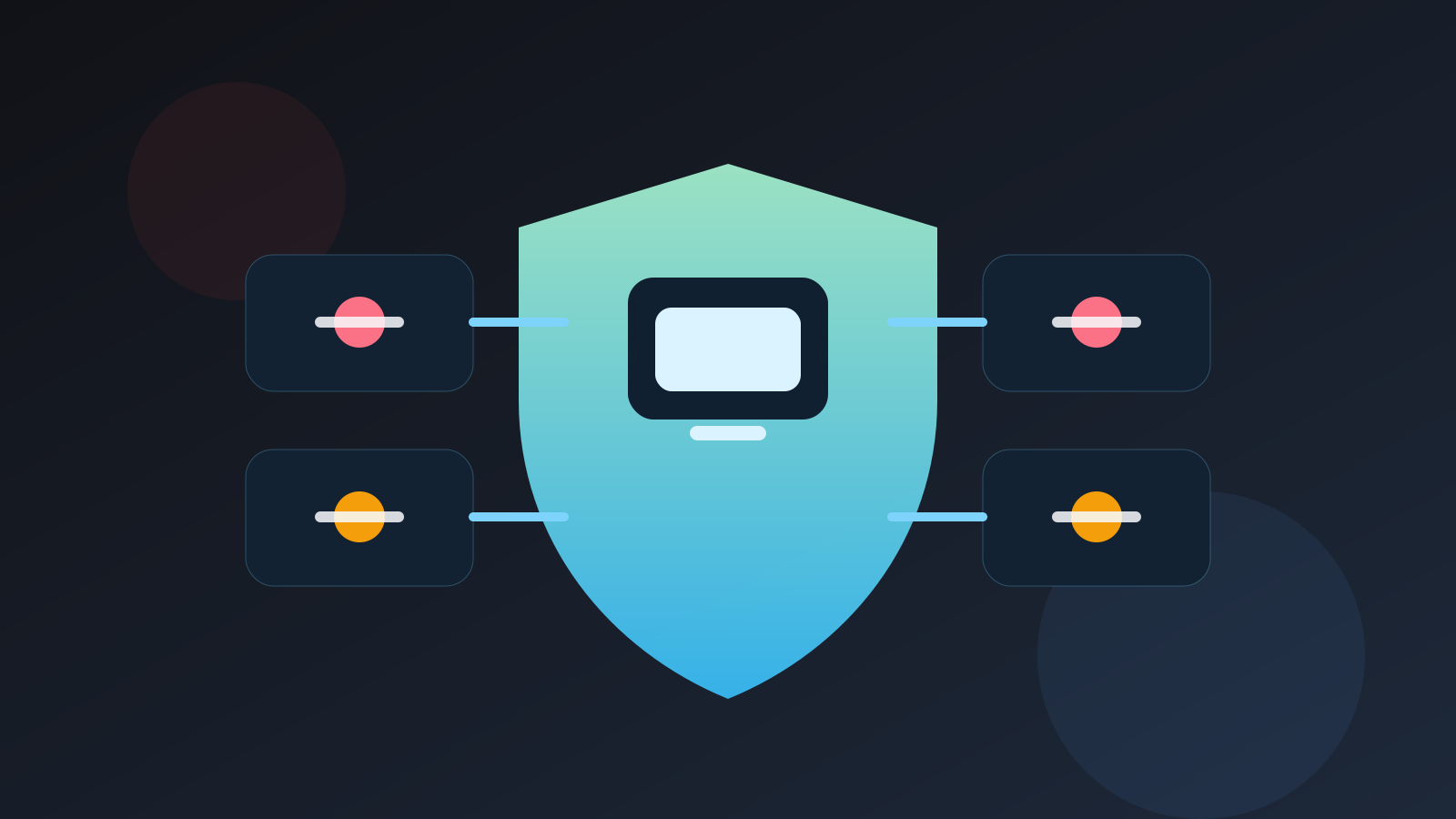
The June 17 browser updates are a reminder to rethink patch urgency
SecurityWeek reported that Google did not say any of the Chrome issues were being exploited in the wild. That is good news, but it should not be misread as low urgency.
Teams often use “no known exploitation” as emotional permission to delay. That is risky.
By the time public exploitation is widely acknowledged:
- proofs of concept may already exist privately
- exploit chains may already be under active study
- attackers may be waiting for patch adoption lag
- high-value enterprise fleets may already be fingerprintable by version
Patch prioritization should reflect exploitability characteristics and surface exposure, not just public-confirmed abuse.
The same principle applies to Firefox 152. Mozilla’s advisory does not need to say “currently exploited” for teams to understand the seriousness of privilege escalation, use-after-free, and sandbox-escape categories in a browser context.
What this means for software companies
If you build and operate software, the June 17 patch wave should trigger three specific questions.
1. How dependent is your product operation on browser-admin workflows?
A lot of companies have strong production controls in code but weak assumptions around the browser environments from which staff access dashboards, billing panels, support tools, and deployment systems.
If a compromised browser session can reach powerful internal tools, browser patching belongs in your product-risk model.
2. How quickly can you locate Oracle and similar enterprise dependencies?
If your organization uses Oracle software directly or through inherited business systems, can you answer these quickly:
- which Oracle products are deployed
- where they are internet reachable
- which business functions depend on them
- who owns patch decisions
- what the rollback and outage assumptions are
If not, your real problem is inventory and ownership clarity.
3. Are patch windows aligned with actual severity rhythms?
A monthly high-severity patch cadence means patching cannot remain a special-event process. It needs to be operational muscle memory.
What this means for startups and small teams
Smaller teams can read a post like this and dismiss it as “big enterprise security news.” That would be a mistake.
Even a startup with no Oracle footprint is still affected by the broader lesson:
- browsers are part of your operational perimeter
- third-party vendor surfaces change continuously
- patching is a product reliability discipline, not just a compliance chore
If you are a small team, the best response is not heavyweight process. It is a clean minimum standard:
- auto-update browsers where possible
- keep device-management visibility simple and current
- maintain a basic software inventory
- know which admin tools require the highest trust
- reduce standing privilege in browser-accessible systems
- document who owns patch review for critical vendors
Security maturity is often less about owning expensive tools and more about removing ambiguity.
The hidden issue: patching is still too separated from product thinking
One reason patch work remains frustrating is that many teams still talk about it as if it belongs outside the product conversation.
But patch latency affects:
- uptime
- customer trust
- incident probability
- change risk
- support burden
- insurance posture
- compliance evidence
- executive confidence
That is product risk.
A company that can ship features quickly but cannot patch core systems and user surfaces responsibly is not actually moving fast in a durable way. It is just moving with hidden operational debt.
This is especially true when enterprise vendors shift cadence. Oracle’s move toward monthly critical security patching is a signal that the old quarterly comfort zone no longer matches the urgency of severe issues.
A practical response plan for teams this week
If your team wants to turn patch headlines into useful action, do this.
1. Review browser update enforcement
Confirm current Chrome and Firefox versions across managed devices. Check whether auto-update, restart enforcement, and version visibility are working in reality, not just in policy documents.
2. Map privileged browser workflows
List the web interfaces that matter most:
- production admin panels
- cloud consoles
- finance systems
- customer support tooling
- identity and SSO administration
- CI/CD dashboards
Then ask whether browser compromise on a staff device would create material business risk.
3. Revisit Oracle ownership and exposure
If Oracle products exist anywhere in the environment, identify:
- product owner
- platform owner
- exposure level
- patch timeline
- outage constraints
- compensating controls
Do not let “owned by another department” become a visibility blind spot.
4. Move to patch triage by exploit path, not only vendor severity
Severity is important, but operational exposure matters more. A high-impact bug on a directly reachable or privileged surface may deserve more urgency than a nominally worse flaw in an isolated system.
5. Use monthly cadence as a forcing function
Do not treat recurring severe updates as noise. Treat them as evidence that your patch process should be lightweight enough to repeat often.
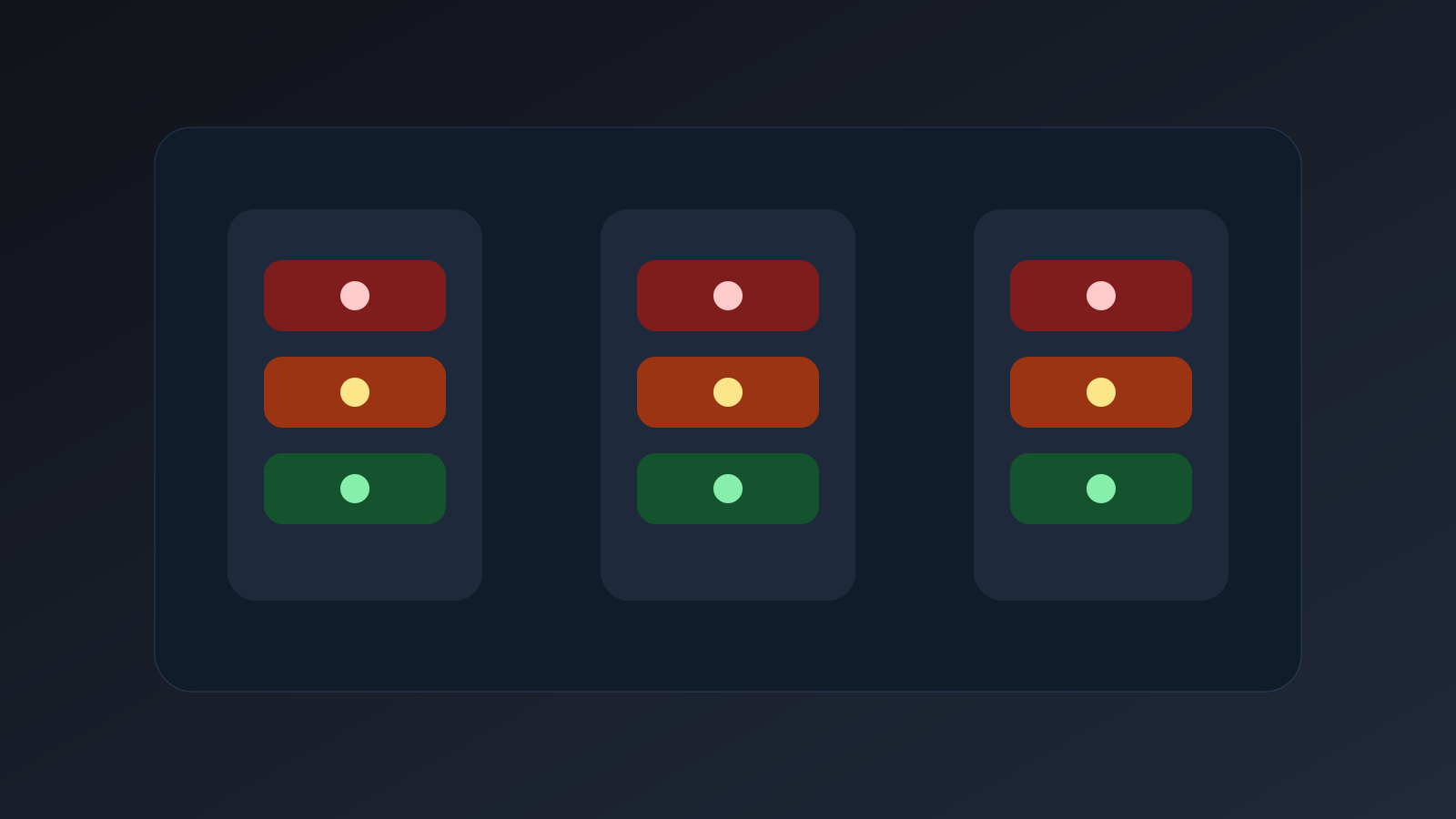
How to measure whether your patch process is actually improving
A lot of teams say they take patching seriously, but they only measure whether tickets were eventually closed. That is not enough.
If the June 17 patch wave tells us anything, it is that patch discipline should be measured more like an operational capability than a paperwork exercise.
Useful questions include:
- How fast do we know whether a vendor bulletin affects us at all?
- How fast do we know where the affected software is deployed?
- How many affected systems are internet reachable or privilege-adjacent?
- How long does it take to move from advisory review to patch decision?
- How often are browser restarts or client updates delayed by user behavior?
- Which systems repeatedly miss target patch windows and why?
Those questions reveal much more than a raw “patched versus unpatched” percentage.
For example, an organization can have a high patch completion rate and still be weak if it takes too long to identify exposed systems. Another can patch browsers quickly but remain exposed through privileged internal tools running on unmanaged contractor devices. A third can patch Oracle infrastructure responsibly but leave admin access patterns too dependent on long-lived browser sessions.
The point is not to build a giant scorecard. The point is to expose friction in the actual response path.
Why customer-facing SaaS teams should care even without Oracle in the stack
Some SaaS teams will read Oracle-specific news and tune out because they do not run E-Business Suite or Fusion Middleware. That misses the broader lesson.
The real cross-cutting pattern here is that severe vendor fixes are arriving across every layer that modern SaaS companies touch:
- employee endpoints
- browser sessions
- identity systems
- middleware and supporting business software
- cloud consoles
- CI and admin interfaces
Your customer-facing application may be built on a modern stack, but the business that operates it still depends on vendor software around the edges. Finance, HR, support, analytics, identity, internal tools, and browser-based consoles all become part of the company’s effective attack surface.
This matters because many incidents begin off the “main product path.” They start in support tooling, internal portals, admin workflows, stale browser sessions, or neglected enterprise components that nobody on the product team thinks about day to day.
That is why patch awareness belongs inside product leadership, not only inside IT or security operations. If a compromise in a non-product system can lead to customer impact, downtime, or data exposure, it is part of product resilience whether teams like that framing or not.
What good teams do differently
The most resilient teams tend to share a few habits:
- They know what they run.
- They know who owns what they run.
- They know which user and admin paths are most privileged.
- They can distinguish patch noise from meaningful exposure quickly.
- They do not wait for perfect certainty to act on obvious high-risk categories.
That sounds basic because it is basic. Security posture often degrades not because teams lack intelligence, but because the basics are fragmented across tools, departments, and assumptions.
The June 17 patch wave reinforces that point. Oracle, Chrome, and Firefox are different vendors with different products and different customer realities. Yet the operational lesson is the same: the cost of ambiguity is rising.
The Diveno Labs take
The June 17, 2026 patch wave matters less as a headline and more as a pattern.
Oracle is accelerating its serious-fix cadence through monthly Critical Security Patch Updates. Chrome is still fixing clusters of critical memory-safety bugs in one of the most exposed software surfaces on the planet. Firefox is still shipping high-severity fixes across privilege, networking, graphics, and sandbox boundaries. None of that is unusual anymore, and that is exactly the point.
Security maintenance is no longer a background admin routine. It is a continuous product and operations discipline.
For leaders, the right question is not “How many patches shipped?” It is:
- Do we have enough visibility to know what affects us?
- Do we patch based on real exposure and privilege?
- Are our browser and admin surfaces being treated as product-risk layers?
- Can our process handle a monthly severe-fix rhythm without chaos?
Teams that can answer yes to those questions will handle this era better than teams still waiting for a calmer patch landscape to return. It is not returning.
Source notes
Sources checked on June 18, 2026:
- Oracle Critical Security Patch Update Advisory - June 2026
- SecurityWeek: Oracle’s Second Monthly Security Updates Deliver 245 Patches
- Chrome Releases: June 2026 stable desktop update entry for June 16, 2026
- Mozilla Security Advisory MFSA 2026-57: Security Vulnerabilities fixed in Firefox 152
- SecurityWeek: Chrome and Firefox Updated to Patch Critical, High-Severity Vulnerabilities
Image notes:
- Featured editorial photo: Cybersecurity Operations at Port San Antonio, public domain via Wikimedia Commons
- All other visuals in this post are original Diveno Labs diagrams created for this draft
Frequently asked questions
What happened in the June 17, 2026 security patch wave?
Oracle released its second monthly Critical Security Patch Update with 245 patches, while Chrome and Firefox also shipped browser updates addressing critical and high-severity bugs.
Why should software and product teams care about browser patch releases?
Browsers are part of the application surface for users, employees, support teams, and administrators. Critical browser flaws can become enterprise risk fast when patching lags.
What is the main lesson from Oracle's monthly patch cadence?
High-severity fixes are moving on a faster operational rhythm, which means teams need patch triage habits that work every month rather than only around large quarterly security events.
Build with Diveno Labs
Turn this idea into a working system.
Share the workflow, product, or content bottleneck you want to improve. We will help shape it into a practical build.
Talk through your product security workflow