
AWS made one of the clearer enterprise AI moves of the week on June 17, 2026. At AWS Summit New York, the company did not just announce another model, another benchmark, or another vague “agentic” vision slide. It added two practical building blocks to Amazon Bedrock AgentCore that directly target the pain most serious teams hit after the demo phase: current information access and proprietary knowledge retrieval.
The two launches that matter most are:
- Web Search on Amazon Bedrock AgentCore
- Amazon Bedrock Managed Knowledge Base
Taken together, they show AWS trying to turn Bedrock AgentCore into more than an orchestration shell. The message is straightforward: if you want to build production AI agents that can use internal documents, stay grounded on current facts, and remain inside a governed AWS environment, AWS wants to provide more of that stack as managed infrastructure instead of leaving teams to wire it together themselves.
That matters to Diveno Labs readers because most practical AI product work in 2026 is no longer about “can the model answer a question?” The harder problem is operational: how do you connect the model to real data, keep answers current, enforce boundaries, and avoid creating an expensive custom mess that only works for one pilot?

The short version
Here is the high-level takeaway.
AWS is trying to reduce the amount of undifferentiated engineering work required to ship production AI agents. According to AWS’s June 17 summit roundup, the new AgentCore capabilities are about connecting agents to organizational knowledge, web knowledge, and operational controls that scale beyond prototypes. The standalone AWS launch posts make that strategy even clearer.
For builders, that means three important shifts:
- Current web grounding is becoming a first-class managed tool rather than an external add-on.
- Enterprise RAG is moving toward a more opinionated managed default.
- Gateway, governance, and observability are being pushed closer to the center of the agent stack.
If you are a founder, product lead, or engineering team trying to turn an internal AI workflow into an actual product, this is the kind of release that deserves attention. It does not mean every team should move to Bedrock tomorrow. It does mean AWS is sharpening its answer to a real market question: what does an enterprise-safe agent platform need beyond access to a large language model?
What AWS actually announced
AWS’s summit roundup on June 17 describes new AgentCore capabilities as tools for connecting AI agents to organizational, web, and paid knowledge, while also helping teams improve and govern those agents as they scale. That framing matters because it is about the system around the model, not the model alone.
The two launches with the clearest practical implications are:
1. Web Search on Amazon Bedrock AgentCore
AWS says Web Search is now generally available on Bedrock AgentCore as a fully managed tool that lets agents ground responses in current, cited web knowledge with zero data egress from the customer’s secured AWS environment. The same post says it runs through a built-in connector target on Bedrock AgentCore Gateway using the Model Context Protocol, returning relevant snippets, titles, source URLs, and publication dates that the model can reason over.
This is a stronger story than simply saying “our model can browse.” It is really an infrastructure claim:
- the search capability is managed by AWS
- the results come back in a structured form
- the grounding includes citations and dates
- the queries do not have to be routed through a separate third-party search API
AWS also says the service uses Amazon’s web index plus structured knowledge graph data. That is important because it suggests AWS is trying to compete on retrieval quality, not only on deployment convenience.
2. Amazon Bedrock Managed Knowledge Base
AWS also launched Bedrock Managed Knowledge Base on June 17, describing it as a way to build enterprise-grade generative AI applications with proprietary data in minutes. The launch post says the service abstracts storage, retrieval, embeddings, re-ranking, and foundation-model selection into a single managed primitive.
AWS specifically calls out three core capabilities:
- native data connectors
- Smart Parsing
- Agentic Retriever
At launch, the native connectors include Amazon S3, SharePoint, Confluence, Web Crawler, Google Drive, and OneDrive. Smart Parsing is meant to choose appropriate parsing strategies automatically across data types and connectors. Agentic Retriever is framed as support for more complex multi-turn, multi-hop retrieval within or across knowledge bases.
AWS also says Bedrock Managed Knowledge Base auto-manages a default embeddings model, re-ranker, and foundation model unless a team wants to tune those choices later.
Why these two launches belong together
Many teams treat internal retrieval and external grounding as separate problems. Technically they are. Product-wise they are usually one workflow.
A useful enterprise agent often needs both:
- private organizational knowledge
- current external information
Consider a few common scenarios:
- A sales assistant needs internal pricing guidance plus current competitor announcements.
- A support copilot needs internal runbooks plus current service-status or vendor-documentation changes.
- A compliance assistant needs policy documents plus newly published regulator notices.
- A security analyst assistant needs internal asset context plus current CVE, advisory, or vendor-patch information.
Without both layers, the agent is either outdated or disconnected from the business.
That is why the June 17 AWS announcements fit together so cleanly. Managed Knowledge Base covers the internal retrieval side. Web Search covers the fresh external knowledge side. AgentCore Gateway acts as the mediated interface through which those tools can be exposed to agents. That is not the full enterprise AI stack, but it is much closer to one than a basic chat-with-your-documents offering.

The deeper signal: enterprise AI is shifting from model selection to data access design
There was a period when AI platform conversations mostly centered on which model to use. That still matters, but it is no longer the main blocker for many teams.
In practice, enterprise teams get slowed down by questions like these:
- How do we connect to SharePoint without building a fragile one-off connector?
- How do we preserve permissions?
- How do we parse messy PDFs, wiki pages, and mixed file formats without hand-tuning everything?
- How do we let the agent use current web information without sending enterprise traffic to unmanaged tools?
- How do we observe what retrieval actually did before the model generated an answer?
- How do we move from a ten-user pilot to a hundred teams without rewriting the plumbing?
AWS’s June 17 releases are really answers to those questions.
That is why this matters beyond AWS customers. Even if your team prefers another cloud or a more custom stack, the product direction is revealing. Vendors are being pushed to solve the integration, governance, and retrieval layer, because that is where real deployment friction lives.
Why Web Search is more important than it first sounds
Web-connected AI is not new. What is new is the degree to which current-information access is becoming part of the managed enterprise story.
Many agent prototypes use external search APIs or custom browsing tools. That works well enough during experiments. It becomes awkward once security, cost review, latency, observability, and procurement enter the conversation.
AWS’s Web Search pitch tries to remove those objections:
- no separate search API contract
- no extra custom browsing infrastructure
- structured retrieval output
- current citations and publication dates
- traffic stays in AWS’s controlled environment
The post also says Web Search is generally available in US East (N. Virginia), and that teams pay only the data transfer charges used by the Gateway. For some builders, that cost framing may make experimentation easier than starting with a separate external provider.
The practical implication is simple: grounded current information is becoming table stakes for serious agents.
If an AI assistant cannot reason over what changed yesterday, it is often not trustworthy enough for product, operations, support, or analysis workflows. Teams have tried to solve that problem in ad hoc ways. AWS is now trying to make it a native Bedrock pattern.
Why Managed Knowledge Base matters even if you already know how to build RAG
A lot of experienced engineering teams can build a retrieval pipeline already. That is not the point.
The point is whether they should keep rebuilding the same pieces.
AWS’s Managed Knowledge Base launch is basically an argument against repeated custom assembly. The service is positioned as a way to avoid spending time on the same infrastructure categories over and over: storage, retrieval, embeddings, re-ranking, connector maintenance, and operational scaling.
That matters because RAG work often gets underestimated.
The first version is easy:
- load some files
- chunk them
- embed them
- store vectors
- query them
The production version is where the real cost appears:
- mixed document types
- broken tables
- permission inheritance
- connector failures
- resync logic
- source freshness
- evaluation drift
- retriever tuning
- model-selection drift
- cost-performance tradeoffs
AWS is trying to make that less bespoke.
That does not mean every team should abandon custom retrieval. If your application depends on unusual ranking logic, specialized domain parsing, or very strict control over every retrieval step, a custom stack can still make sense. But for many teams, the real business value is not in owning the ingestion and re-ranking plumbing. It is in the application behavior built on top of it.
What this means for product teams building internal copilots
Internal copilots are usually where this kind of release lands first.
A lot of companies are in the same phase right now:
- the first chatbot proved user interest
- the second version connected to one system
- the third version exposed operational gaps
Those gaps are usually not about the language model sounding smart enough. They are about reliability and boundaries.
When a team asks, “Can we roll this out more widely?” they are really asking several other questions:
- Can it access the right data?
- Can it avoid the wrong data?
- Can it cite what it used?
- Can it stay current?
- Can we see what went wrong when it fails?
- Can we operate it without adding a full-time platform team just to keep it alive?
AWS’s AgentCore roadmap is clearly targeting that decision point.
For product teams, the more useful framing is not “AWS launched another AI feature.” It is “a major cloud vendor thinks managed retrieval and governed tool access are now core parts of the agent platform.”
What this means for startups
Startups should read the launch a little differently from large enterprises.
For a startup, the main value is not that AWS has a complete enterprise governance story. The main value is that AWS is reducing the amount of platform work a small team might otherwise have to own too early.
If you are building:
- an AI workflow layer for professional services
- a document-heavy B2B assistant
- a support automation product
- an internal knowledge tool for a vertical niche
- a research or monitoring product that mixes private and public information
then the question is whether managed components can shorten your time to a credible product.
That can be a strong trade:
- less infra assembly
- faster launch
- easier security review
- more predictable operational boundaries
The tradeoff, of course, is platform dependence. The more you adopt a managed gateway, managed knowledge layer, and managed grounding tools, the more your architecture conforms to the vendor’s product model. For some startups that is a feature. For others it creates long-term portability questions. The answer depends on whether speed now matters more than deep infrastructure independence later.
The governance angle is just as important as the retrieval angle
The AWS summit roundup explicitly frames the new AgentCore capabilities as part of a broader governance and improvement story. That is easy to miss, but it is one of the most important lines in the release.
The market has largely moved past the idea that an “agent” is only a prompt plus a model. A production agent is a governed software system:
- it has tools
- it has credentials
- it has policies
- it has failure modes
- it has audit needs
- it has user-trust consequences
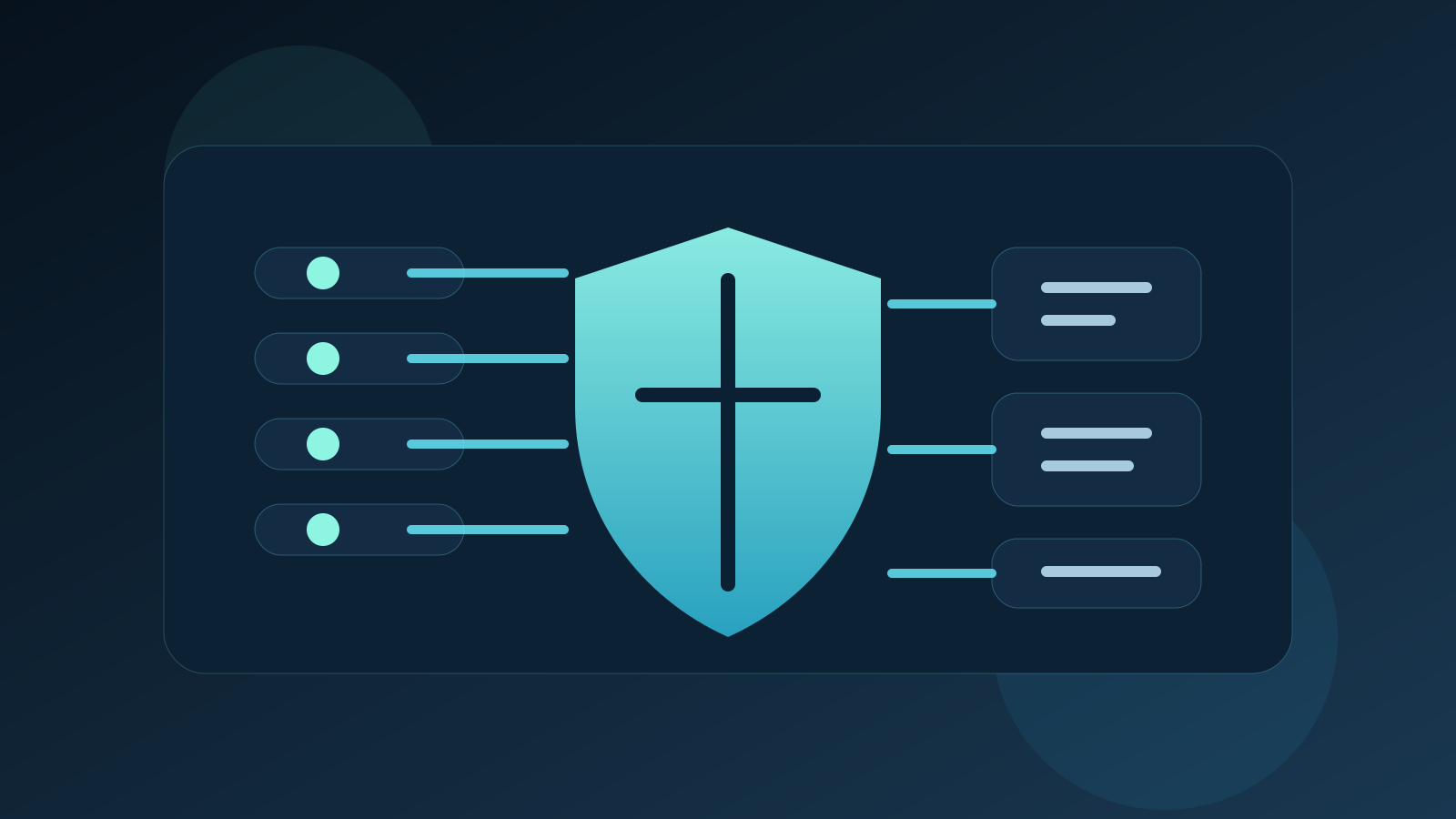
That is why Bedrock AgentCore Gateway matters in the background of both launches. Gateway is effectively the control point through which tools and connectors become available to the agent. The more tool use expands, the more important that mediation layer becomes.
The best way to think about it is this:
The model is not the product boundary anymore. The boundary is the tool-and-data perimeter around the model.
That is where teams decide:
- what an agent can see
- what an agent can call
- where those calls go
- what telemetry is captured
- how risk is constrained
What engineering leaders should do now
If you lead an AI application team, the right response is not to rewrite your stack because of one launch post. The right response is to revisit your architecture assumptions.
Use this checklist.
1. Separate “model quality” from “system quality”
If your team is still discussing AI performance mostly in terms of which model sounds best, you may be focusing on the wrong layer. Review how much of your current reliability problem actually comes from retrieval, freshness, permissions, or tool governance.
2. Map internal versus external knowledge needs
List the workflows where your AI assistant needs:
- only internal data
- only current external data
- both at the same time
The “both” category is where the AWS June 17 launches are most strategically relevant.
3. Audit connector maintenance cost
Count how many integrations your team is already supporting or planning to support. Then ask how much value comes from owning those connectors versus using a managed option.
Custom connectors feel fine until they become a roadmap tax.
4. Decide how much retrieval control you actually need
Some teams need deep control and should keep it. Others mostly need decent defaults, secure access, and faster delivery. Be honest about which category you are in.
5. Treat observability as part of retrieval design
An answer is only as debuggable as the retrieval path behind it. If a user gets a bad response, can your team explain:
- which source was searched
- which snippets came back
- whether permission filtering worked
- whether the data was stale
- whether the model ignored the best evidence
If not, your AI quality problem is partly an observability problem.
When a managed stack is the right choice and when it is not
One mistake teams make after launches like this is turning the choice into ideology.
Some engineers hear “managed knowledge base” and assume it means oversimplified RAG for nontechnical buyers. Other teams hear “fully managed web grounding” and assume custom approaches are now obsolete. Neither conclusion is serious.
The better question is: which parts of the stack are actually strategic for your product?
Managed components are a strong fit when:
- your core differentiation is in workflow design, not retrieval plumbing
- you need to connect several common enterprise content systems quickly
- your buyers care more about governance and deployment speed than low-level tuning
- your team is small and cannot justify owning a dedicated retrieval platform
- your app must combine private documents with current public information on a short timeline
Custom-heavy approaches still make sense when:
- retrieval is your product moat
- you need unusual ranking or retrieval-control logic
- your data model is highly specialized and poorly served by generic connectors
- you must optimize every cost/performance layer aggressively
- you expect to be multicloud or infrastructure-portable by design
The reason this distinction matters is that teams often choose a stack for the wrong reason. They choose custom because it feels more sophisticated, or managed because it looks faster in a demo. The better choice usually comes from knowing exactly where your competitive value lives.
If your users are buying the quality of your decision support, your workflow, your domain understanding, and your execution speed, then a managed retrieval layer may be an excellent trade. If your users are buying the retrieval system itself, you should be much more careful about abstracting it away too early.
What teams should not misunderstand about this release
There are also a few bad readings worth avoiding.
This is not a guarantee of accurate answers
Managed retrieval improves the system design, but it does not automatically solve answer quality. Teams still need evaluation, prompt discipline, source design, fallbacks, and user-interface patterns that distinguish confidence from uncertainty.
This does not remove the need for data cleanup
Native connectors are useful. They do not magically fix poor internal information architecture. If your knowledge lives in outdated wikis, contradictory documents, and unclear ownership boundaries, retrieval can surface that mess more efficiently, but it cannot invent clean source governance for you.
This is not only for giant enterprises
The messaging is enterprise-heavy, but the product implications also matter for small product teams. A startup building a vertical assistant may benefit from this kind of managed stack more than a large company with a mature platform team.
This is not only a cloud story
It is a product-design story too. The more your AI system can see and do, the more important it becomes to define what it should not do, what it should cite, and how it should fail. Managed infrastructure helps, but product boundaries still need to be designed intentionally.
What Diveno Labs would watch next
This launch is meaningful, but the next questions are still open.
Retrieval quality in messy real data
The marketing story sounds strong. The real test is whether the defaults work well on mixed enterprise content with permission complexity and ugly document structure.
Operational ergonomics
How much easier is day-two operations? Can teams monitor sync issues, retrieval drift, and access edge cases cleanly? Managed components win or lose on that experience.
Pricing at scale
Managed convenience is attractive. The real decision often depends on whether it stays attractive once a workflow becomes large and frequent.
Multi-region maturity
Web Search being generally available in US East (N. Virginia) is a useful start, but enterprises with regional constraints will care about broader availability before making it a central dependency.
How much vendor lock-in teams accept
The more capable the managed stack becomes, the easier it is to move quickly and the harder it can be to stay portable. That tension is not unique to AWS, but it becomes sharper as more agent infrastructure moves into managed primitives.
The Diveno Labs take
The June 17 AWS announcements matter because they are not trying to make Bedrock AgentCore look more futuristic. They are trying to make it more deployable.
That is the right direction.
Most organizations do not need another AI demo. They need systems that can connect to enterprise content, use current outside knowledge, respect security boundaries, and stay operable when usage grows.
Web Search on AgentCore matters because current information is now part of the managed platform story. Managed Knowledge Base matters because enterprise retrieval should not require every team to keep reinventing connectors, parsers, and ranking plumbing. AgentCore Gateway matters because the tool layer is becoming the real control surface for production agents.
For builders, the lesson is broader than AWS:
- the center of gravity is moving toward data access design
- grounding is becoming a default expectation
- agent platforms are being judged on governance and operations, not only on inference
That is exactly where practical AI product work is heading.
Source notes
Sources checked on June 18, 2026:
- AWS News Blog: Top announcements of the AWS Summit in New York, 2026
- AWS News Blog: Announcing Web Search on Amazon Bedrock AgentCore
- AWS News Blog: Introducing Amazon Bedrock Managed Knowledge Base
Image notes:
- Featured editorial photo: Technician with laptop working on server rack at NERSC, CC0/public-domain waiver via Wikimedia Commons
- All other visuals in this post are original Diveno Labs diagrams created for this draft
Frequently asked questions
What is the most important Bedrock AgentCore update from June 17, 2026?
The most important update is that AWS combined current web grounding and enterprise knowledge retrieval into more managed AgentCore building blocks, which lowers the amount of custom plumbing teams need for serious AI agents.
Does Bedrock Managed Knowledge Base replace custom RAG pipelines completely?
Not for every case, but it removes a lot of repeated infrastructure work for teams that mainly need secure connectors, retrieval quality, and operational simplicity rather than total low-level control.
Why does Web Search on AgentCore matter for enterprise teams?
It matters because many agent workflows need current external facts, but regulated teams do not want to send prompts and retrieval traffic through unmanaged external search APIs.
Build with Diveno Labs
Turn this idea into a working system.
Share the workflow, product, or content bottleneck you want to improve. We will help shape it into a practical build.
Plan an AI product with Diveno Labs